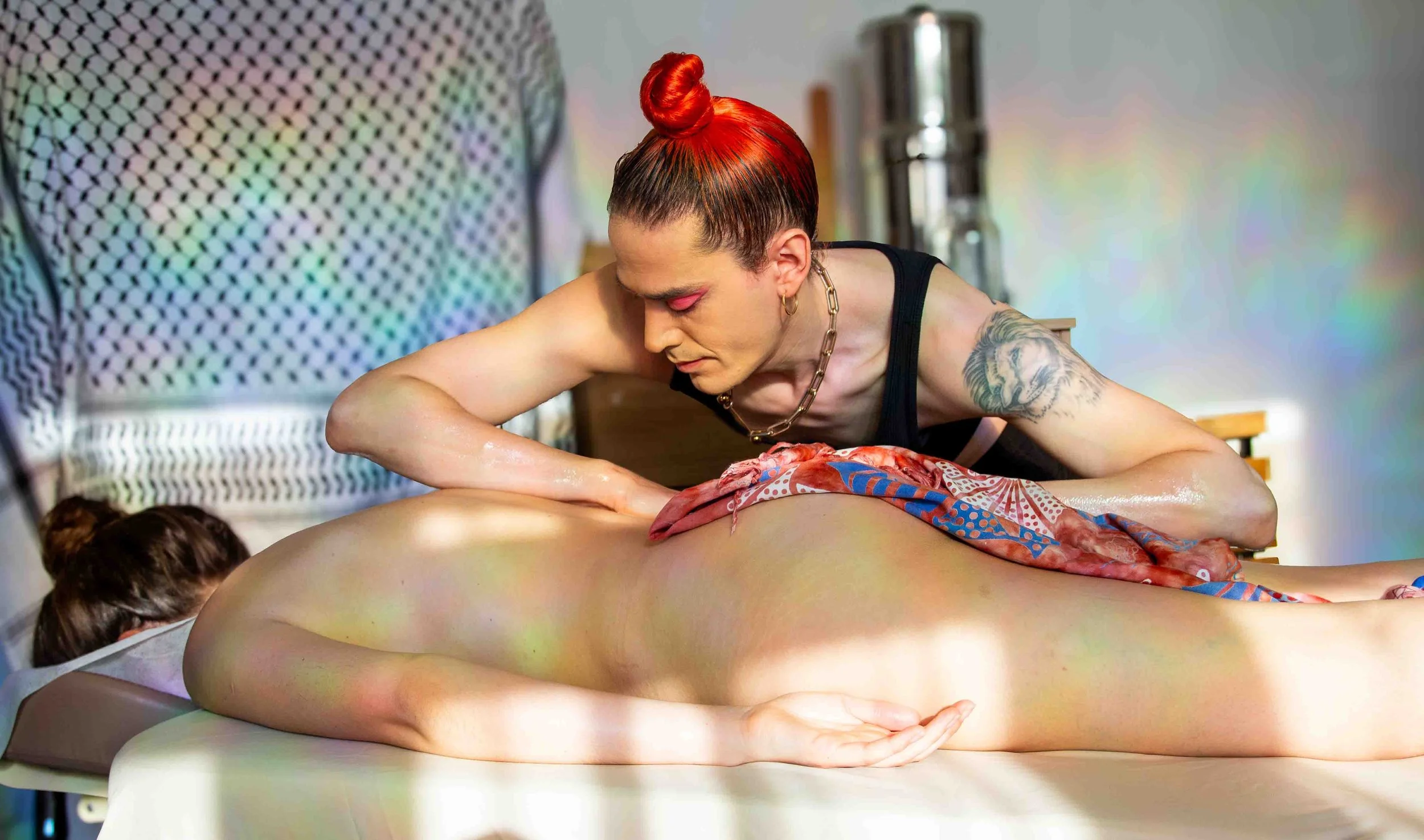
receive 1:1
1:1 sessions offering space to soften, rest and return to your body
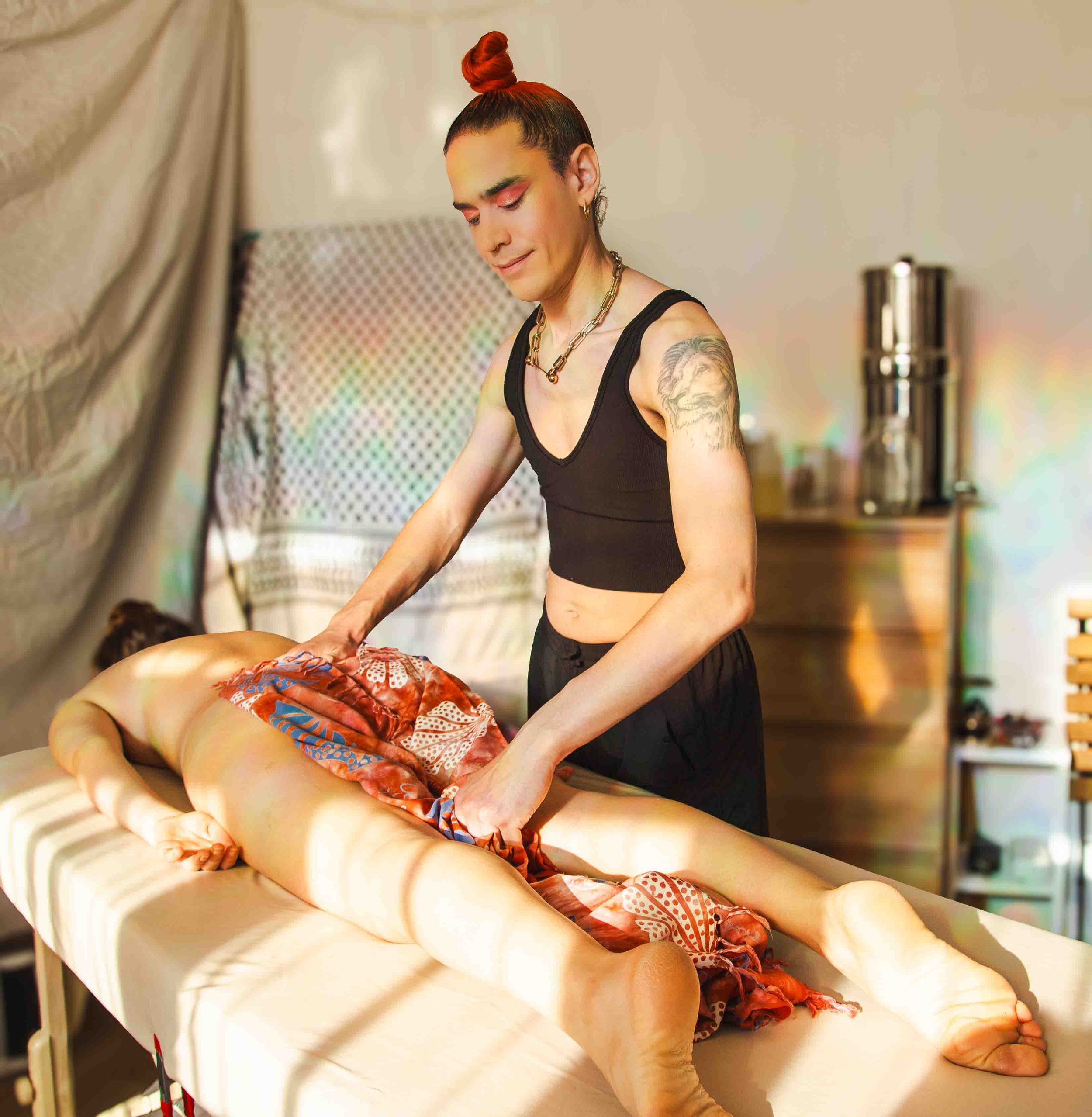
working together
each session is shaped through listening, consent, and your body’s pace. you’re welcome to arrive as you are. we’ll find a rhythm that works for you.
this is an entirely non-sexual practice. [60, 90 or 120 minutes · £60–£170 sliding scale]
-
sessions are shaped through slow, continuous touch, guided by consent, attention, and the pace of your nervous system.
i generally recommend beginning with a longer session. time allows the body to settle, for trust to build, and for spaciousness to unfold. anxieties and urgencies can momentarily dissipate. this creates the conditions for deeper rest, awareness, relation and relaxation.
the work draws from lomi lomi, with long, flowing strokes using hands and forearms, combined with attentive listening to your body throughout.
rather than working toward a fixed outcome, sessions help support a shift in pace, particularly from tension or vigilance toward spaciousness, and a tactile quality of being in the body. -
roughly how a 90-minute session goes. nothing here is fixed - it's so you know the shape before you arrive.
first, we talk (10–15 mins). if it's your first time i’ll walk you through the whole thing. if you’ve been before, we check in: how you’re arriving, what’s going on, anything you want the session to hold. no touch yet.
getting on the table. i’ll leave the room. you unrobe and lie face-down under the clean sarong with your head face-down in the cradle. let me know when you're ready. i’ll knock before i come back in.
the table can be heated and you can have it as warm as you like. there’s music unless you’d rather have quiet. tell me either way, at any point.
settling. following the greeting, i start with a still hold - hands resting, nothing moving. it sounds like very little, but it’s how your body works out that nothing sudden is coming. some people’s breathing changes in the first thirty seconds.
oiling the back (about 25 mins). slow, continuous strokes with warm oil, and long restful holds. it’s more spacious than you’re expecting. that’s deliberate - pace is what lets a nervous system come down, and i’d rather cover less surface properly than all of you quickly.
if you want more focused work anywhere, say so and i’ll fold it in.
turning over (midpoint). you turn onto your back and i re-drape you before we carry on.
the chest-sternum area. i ask directly what you want for your chest-sternum area, from completely covered to nothing covering at all. see [draping and what you wear] for how that works.
front of the body (about 25 mins). the same rounds of oiling. from here we can stay with the full-body flow, or give time to particular areas.
closing. the session ends with a foot-washing ritual - warm water, a towel, unhurried. then i leave you to come back to yourself. no rush off the table, no rush out of the door. talk if you want to, or don't say a word.
throughout: you're covered with the sarong staying between us the whole session - full details on this are below in [draping and what you wear].
you can pause, change, slow down or stop anything, at any point, without giving a reason - and you don’t need a good reason, “i don’t want that” is complete. falling asleep is fine, so is crying. neither means the session went wrong, and neither gets made into an event. -
i work slowly, i stay present, and i promise to work in a way you can feel is safe, rather than asking you to take my word for it.
i don’t come in with a plan for your body. this way of working comes out of years of welfare and safeguarding work in nightlife. a lot of time spent being the calm person in a loud room, with people having a hard night who didn’t want to be handled.
non-sexual, plainly. this is an entirely non-sexual practice. there’s no sexual or intimate touch at any point, and it isn’t open to negotiation. any sexual request ends the session immediately, and there’s no refund.
nothing is assumed. we agree what’s included and what’s left out before we start, and nothing gets quietly reintroduced later. if you’d rather i didn’t go near your feet, or your neck, or your stomach, that’s the session. no persuasion, no coercion, no gentle encouragement, no asking twice.
the tap system. talking is sometimes the last thing you want to do on a table. so there’s a way to change something without speaking:
one tap - slower, or lighter
two taps - move away from there, or stop
lifting my hand from your body - everything stops. i take my hands off and wait
after a hand lift, what happens next is entirely yours to decide. carry on, change something, sit up, or finish early. the rest of the time is yours either way, whatever you choose.
you can tap the table or my arm, or take hold of my hand and move it. i'll respond without asking why. it’s yours to use as often as you want, and there’s no threshold you have to meet before it counts. speaking works just as well, whenever you’d rather.
if you can't reach for any of it in the moment, that’s ordinary too. i’m watching for changes in your breathing and your body, and i’ll stop and check in myself if something shifts.consent at the start, and after. we set things up at the beginning so you’re not being asked how you’re doing every four minutes, which is its own kind of work. that’s not a decision you’re locked into. you can change or withdraw anything at any point, by speaking or tapping. what’s agreed at the start is a floor, not a contract.
if you process differently. silence is always an option. you never have to make conversation, and not talking won’t be read as anything. if there’s a way of communicating that works better for you, or something about the room, the light, or the touch that would help to know in advance, tell me before we start and i’ll set it up.
no outcome i’m working towards. i’m not assessing your posture, hunting for knots, or trying to get you somewhere by the end. some sessions are quiet and uneventful. that isn’t a session that failed.
for how the sarong is used, what you wear underneath, and the chest and sternum, see [draping and what you wear].
-
what you wear underneath is up to you. traditionally this work was received ceremonially and undressed, with the sarong doing the covering. you can keep your own underwear on if you’re happy for it to get oily, or use the disposable underwear that’s provided. all three are completely fine, and you can decide before you get on the table.
how draping works. the sarong is arranged once at the start, and it holds for the whole first half.
lying face down, it’s drawn down to sit just above the buttocks, folded carefully and tucked between your legs so you stay covered there throughout. i work the full length of both legs and your back, oiling and gliding carefully around it.
you’ll feel the fabric being drawn down and settled back as areas are uncovered and covered again. that sensation belongs to the session as much as the oil does.
turning over. when the back is finished, the sarong is unfolded, untucked and drawn back up over you. i lift it carefully into a tent, and you turn over and slide down the table underneath it. you stay covered the whole way, with the sarong between us the entire time.
the tent settles down over you, still covering you fully. that’s where we have the conversation about your sternum, before anything else moves.
the chest and sternum. this part is by your choice, and only yours.
if you’d like it included, the sarong is drawn down and folded across your hips the same way it was on the first side. long strokes travel up from your legs, through your stomach, across the sternum, out to your shoulders, down your arms, and back onto your legs again.
if you’d rather keep it covered, a towel goes over your chest first, on top of the sarong. the sarong is then drawn out from underneath the towel, so the towel stays exactly where it is and your chest stays covered throughout the change. the strokes come up from the belly, fly over the towel, and land on your shoulders instead. the rounds complete either way, and your session is whole however you choose. once you’ve told me, that’s settled for the day.
we agree this at the start, and i ask once more here, at the midpoint, before anything is moved. by then you’ll have felt the pace, and you might want something different from what you pictured in a chair with your coat still on. changing your mind is a normal thing to do, and it’s easy to do.
being honest about this. work across the sternum and stomach is intimate. it’s also entirely non-sexual. those are two different things, and keeping them different is the whole practice. that’s what the draping, the checking in, and the pace are all for.
for the tap system and how consent is set up, see [how i work with consent].
-
if something about your body is changing, or your skin is having a difficult month, tell me at the start and i’ll adjust. here are the most common ones.
if you’re on testosterone, your sebum production increases. skin changes, acne and ingrown hairs are extremely common, especially in the first couple of years. i’ll use a lighter, non-comedogenic oil, bringing an awareness to the direction of hair growth so nothing drags too intensely at new follicles, and go around anything sore.
if you’re on estradiol, skin often gets drier and more sensitive, and chest tenderness is very common early on. i’ll use a richer oil, go lighter, and leave your sternum completely alone on days it’s sore, even if you normally want it included. yes normally, not today is a complete answer.
if you’ve had laser or electrolysis recently, treated skin is sensitive for a few days and oil isn’t great on it. a small area is easy to work around. if you’ve had a lot done, message me and we’ll move your session - no charge, whatever the notice.
if you’ve had top surgery, scar tissue can be worked with or left entirely alone, at any stage. if sensation is patchy or reduced anywhere, tell me, so i’m not relying on you to notice pressure you might not feel.
if you bind, the rib and upper back tightness that comes with it is one of the most common things i work with.
anything else - eczema, psoriasis, a new tattoo, chronic pain, hypermobility, a scent you can’t be near - the same applies. there are several oils here and i’ll patch test on your forearm before we start if you’d like.
none of this is unusual. come as your body is on the day.
-
some bodies want more. if there's somewhere that’s been holding for months, we can spend real time there - applying the fleshy part of the forearm, elbow, fists or knuckles where it helps.
it goes in slowly, folded into the rhythm rather than interrupting it. no sudden change of gear, no ten minutes grinding at one shoulder while the rest of you waits.
deep doesn’t mean painful. i work at the edge where tissue starts to give rather than pushing through it, which tends to get further anyway. you set that edge quietly or out loud, as often as you like - slower, lighter, stay there, move on.
feel free to ask for this before we start, or halfway through, or not at all.
-
arrive in comfortable clothing that you don’t mind getting a little oil on
avoid heavy meals just before your session
if you can, give yourself some time away from screens before and after, to support your arrival into the session
bring a towel if you’d like to have a quick shower after your session
-
sessions can be received occasionally or as part of an ongoing practice.
some people come at moments of transition, special occasions or intensity. others return regularly to support rest, integration, or connection with their body.
we can find a rhythm that feels supportive and accessible for you.